Ms. Thesis Title: The Effect of Using Chunking Strategies in Memorizing Digits
The memorization of a high volume of information is not possible unless it is organized or broken into pieces. This process of breaking information into smaller pieces, suitable for memorization, is called chunking. Although the research on memory capacity and memorization strategies started over 60 years ago, however, the knowledge of chunking is not yet complete. In his research, the effects of the use of chunking strategies in memorizing sequences of digits are measured on the performance of individuals through a computerized assignment. The computer assignment is composed of two modes. In the first mode, subjects can use their own chunking strategy in memorizing sequences of digits. In the second mode, the subjects are guided to use a specific chunking strategy by grouping the digits on the screen. The assignment was conducted on 35 participants, 17 female and 18 male participants. The obtained data was analyzed, and the result show that there was a statistically significant difference between the performances of participants using different chunking strategies. The finding suggests that the most suitable chunking strategy varies across the subjects. The results also show that, people generally achieve lower performance when using their own chunking approach and, teaching them chunking strategies may improve their overall performance. These findings play a key role in the design of interactive human-machine interfaces and cognitive games.
The result of this research has not published yet; We submitted that and we are waiting for the response. You can find full paper here.
B.Sc. Thesis, a shooter game for cloud gaming
I developed a Run and Gun scrolling game for cloud gaming research. Also the eye-tracking system to detect eye movement patterns and extract the region of interest. In addition, we did some research over this game, we used an eye-tracking system in order to track eye movements to extract the region of interest of the players. We tried to find a relation between the skill and the region of interest. We categorized the players in 3 levels of skill and we could distinguish the region of interest of each group precisely. In addition, we provide an eye tracking data set. in following you can find two papers which have been published using “Somi” game.
- S. Mowlaei, S. Schmidt, S. Zadtootaghaj, and S. Möller, “Know your Game: A Bottom-up Approach for Gaming Research,” in Quality of Multimedia Experience (QoMEX), 2018 Tenth International Conference on, 2018
- Hamed Ahmadi, Saman Zad Tootaghaj, Sajad Mowlaei, Mahmoud Reza Hashemi, and Shervin Shirmohammadi. 2016. GSET Somi: a game-specific eye tracking dataset for Somi. In Proceedings of the 7th International Conference on Multimedia Systems (MMSys ’16). ACM, New York, NY, USA, Article 42, 6 pages. DOI: http://dx.doi.org/10.1145/2910017.2910616
Generalized Biped Walking Control:
The Generalized Biped Walking Control project, developed in the University of British Columbia, presents a control strategy for physically-simulated walking motions that generalize well across gait parameters, motion styles, character proportions, and a variety of skills. The control is real-time, requires no character-specific or motion-specific tuning, is robust to disturbances, and is simple to compute.
This project uses ODE (Open Dynamic Engine) for real-time physics simulations, we replaced this physics engine with Bullet Physics Engine. since Bullet Engine uses openCV it can simulate many bipeds in real time, as a result, it can be used in computer games.
After replacing the Bullet physics engine, biped limps a bit, and that’s due to differences between ODE solution and Bullet Solution for Articulated bodies.
Game Engine:
At the middle of my bachelor’s, I decided to develop my own game engine. I felt this way because as a programmer I needed to understand the structure of game engines. I do not use my engine for game development because obviously using popular engines like Unity is more reliable. However, as a bachelor student, I was curious about
how does it look like to developing an game engine and how to integrate different libraries such as graphics library, physics simulation, event handler, sound engine, AI libraries, and others into a whole.
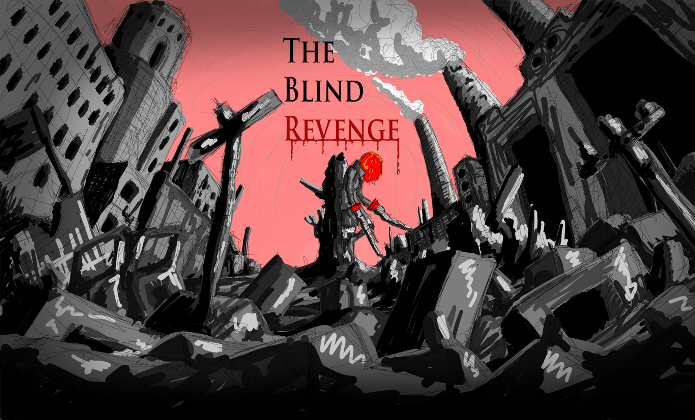
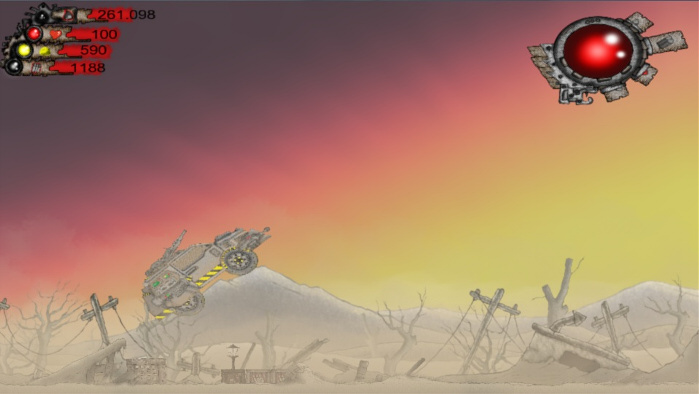
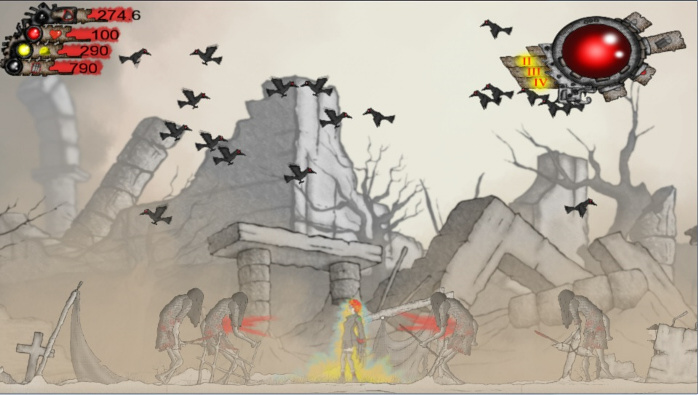
My 2D game engine uses box2D Library for the physics simulations, and SFML Multimedia Library for graphics display, sounds, visual effects, and event handling. I developed a game named “Blind Revenge” by this engine.